Monday, February 28, 2011

Walking in a Winter Wonderland (part 4)


To start 2011 off right, we spent our last day in Stockholm hitting the pavement early.  After dropping our suitcases off at the bus station, we headed towards Djurgarden - yet another of one of the many islands in the archipelago.  Being Royal Land, it has escaped commercialism but instead is a peaceful oasis close to the city center.  Full of old wooden houses, Joseba and I set off to make a loop of the island and admire the playfully colored homes before it got dark. 

With some street food to hold us over until lunch, we made the trek to the island on a tree-lined walkway.  With snow covering the limbs, it felt more like we were walking through a snow tunnel and magically came out at the bridge over to Djurgarden.  With joggers whizzing by and tourists shuffling towards one of the many museums on the island, Joseba and I strolled along the snow-packed roads, without a set destination, just appreciating the woodcarved decorations on the homes, the mixes of stone and wood, the hanging icicles and the smoke puffing out chimneys.
As dusk set, we headed back to the center of the city to meet up with our friends for one last meal before we both headed back to different countries - us again to Denmark and them to Finland.  With enchiladas on the brain, we hit up the Mexican restaraunt we had eaten at the first day again and after walked Laura and Alain to the metro station in the dark.  With only three hours to spare, we continued our destination-less walking tour and stumbled upon Riddarholmen, or 'The Knight's Island' as it translates to.  Home to the very important Riddarholmskyrkan - the church on the island, which has been deemed the final resting place of Royals since the 16th century, the island is packed with buildings that were used in the 17th century.  Now, it is most well-known for its views of the Stockholm skyline.  That evening, it held up to it's popularity, and we were able to see all the lights of the city, Christmas ones and normal ones, shining across the water.

Cold to the bone, we spent the last few hours in and out of shops, and finally in a small restaurant, planning our remaining days in Scandinavia.  Our next stop, which we were excitedly reading about, was to be Malmo.

After about 6 hours on our night-bus, Joseba heard the loudspeaker announce we were coming up to Malmo.  Now, we had originally planned to go all the way back to Copenhagen, drop off the suitcases and make the train trip back across the bridge to Malmo - Sweden's second biggest city and only a stone's throw from the Danish capital.  However, we were lucky and the bus went right past it, so we were able to get off early and save the whole hassle!  The only downside was that we arrived at the bus stop 30 minutes before it opened and had to do some serious dance moves to keep warm until the sliding doors opened at 7:30am.

The wait was made worth it, when the customer service woman explained a bit about Malmo and told us her idea of the must-sees in the city.  Quite comical, she highlighted the clothes stores as an important stop in the city tour.  Even more comical is that she didn't recommend a single store for Joseba, just shops I should go see haha.  Map in hand our first priority was to get a coffee and a small but sweet breakfast.  As the Swedes rushed off to work, either on bike or on foot, we sat warmly in a small café in Stortorget - the Main Square.  Originally Denmark's second biggest city, Malmo didn't actually come into Swedish possession until the early 17th century.  Facing almost extinction, Malmo only could claim 1,500 inhabitants in the mid 1700s due to the war and a viscious plague.  After that though, Malmo slowly grew and grew, with the creation of the Swedish southern railway lines and the founding of the shipyards.  Now, Sweden's southwesternmost city is a welcoming stop for people who travel the almost 5 mile bridget that connects Denmark and Sweden.
Knowing nothing about Malmo or having even had thought of visiting it until the day before, we took our guide books advice for our first 'stop' in town - the pharmacy.  Listed as Sweden's oldest pharmacy, Apoteket Lejonet (Lion Pharmacy) has been in business since 1571.  Housed in a gorgeous brick building, complete with reliefs, a pointy green spire and even a few gargoyles, the building was just as amazing outside as inside with old apothecary bottles lining a mezzanie level above the marble-floored pharmacy that was decorated with original wooden inlays and an ancient looking water fountain.

With the streets almost still deserted, we were happy to wander about the streets, taking in the mix of the antique buildings standing short next to newer and modern office buildings.  On one block you could even see the old buildings reflecting in the all-wall glass building across the street from them.  A strange sight to see for sure.

On the hunt for the popular outdoor food market in the international district, we eventually found out that this market, filled with various types of food from all over the world is more of a summer thing.  Stands to reason, seeing as the temperature at the time was below 20º!  Instead of fret, we kept walking and eventually ended up back the Old Part and somehow right in the middle of the square.  Although we had eaten breakfast in the Main Square, the action in Malmo doesn't really happen there, but instead in a smaller square that was added to the city when they decided thier town was too big for just one square.  This square, Lilla torg, is where all the most popular restaraunts and bars are, and although small, is always said to packed.  Since it was built atop an old marshland, I was happy we didn't sink!

Thanks to our book, we headed through a small passageway into a interior courtyard to die for.  With stone buildings at our backs we were mostly in awe of the bright yellow house facing the street.  With the eye-popping yellow against the dark brown support beams, the house looked as if it might collaspe at any moment.  Seeping into the snow, the uneven tiled roof gave proof that the buildings in Lilla torg were from about the 16th and 17th century!

Near the square we next gazed at Radhus, the town hall, which is topped with varios elaborate statues, some of which date back to the buildings erection date of 1546.  It is said that the restaurant below has been in use as a tavern for more than 400 years!  Continuing our walking we mosied along the river which was full of frozen shoes, bikes and assorted other items, assumably from New Year's Eve.  Right off the river stood a large cemetary all with vertical standing tombstones.  After walking amongst the dead and thier fancy tombs, we headed to the multicultural district yet again, but this time for lunch.  En route we passed Folkets Park, or the People's Park, which during the summer is a small amusement park.  With a cold winter hanging out about though, the rides were halted, the children's laughs silenced and the music cut.  BUT the bathrooms still had working heaters!  Hooray!  Warmed from a bathroom visit we set off in search of food - at a Thai restaurant our book had recommended.  It was a bit sketchy, because the book said that at the time it was written the restaurant was actually illegal and didnt have a food liscense but that the food was so tasty, he was going to point people to it anyways.  Lucky for us, Krua Thai was open, and it seemed to have obtained a liscense because it was quite big and equally busy.  With a lunch menu no one could resist, we dined on stirfried noodles and chicken curry soup. 

With my mouth burning from the extremely spicy curry (which I just love) and Joseba full up to his neck with noodles, we slowly made our return to the city center to catch our bus.  On the way though, I made it a point to pass the Malmohus - a castle from the 15th century.  While our book said it was one of the ugliest castles in Sweden (and I have to agree after having seen it), I was determined to see a castle with a moat.  Never having seen one in my life, I think it is maybe every girl's dream to see a castle with one!  After the very out-of-the-way walk, we arrived only to be disappointed as the booked warned us.  With falling bricks and mismatched colors, it seems believable that this castle was used as a jail at some point and that Mary, Queen of Scots' husband was once inprisoned here.

With the sun quickly setting, we made our way back to the bus station just beat.  Our early morning wake up had been helpful and saved us a lot of time, but also took its toll and when we arrived back in Copenhagen 45 minutes later we ordered a family-size greasy meatsa pizza and a beer and just crashed.  Shamefully, our hostel guests were a large bunch of British men, who drunkingly barged into the room around 4am.  This led to us sleeping in very late the next day and missing almost the entire daylight time.  We did manage to seize a bit of the rays and used them to explore Christiania - a free town - of sorts.  If you read my blogs from my first visit to Copenhagen, I spoke more at length about the community and actually posted some pics, but this time, they were quite ardent about no photos, so I don't have any to share wtih you, so instead I will try and describe what we saw.  Walking into what used to be an old naval base, the citizens of Christiania were mostly dressed in black and sported black beanie hats.  I think every single one was smoking a cigarette or marijuana as they socialized over burn barrels ablazing.  Some sat in cafés that were inside makshift buildings or behind a tarp.  Every where you looked though, you saw what I would call garbage.  Extra windows, random items littering the ground, an old TV here and there but the thing is, that these people took all of these 'junk' items and made them great.  One house, which was falling apart, was painted with bright colors like a sunrise) and the extra windows were placed in a mismatched pattern around the house. Other houses were shaped like houses in India, and others with scrap metal decorations - basically a mix of everything.  For it being mostly trash, the 'look' was quite impressive. 

When we left, we crossed under a sign that said 'Entering the EU' which made us chuckle a bit and we headed towards the Old Part, poking into second-hand shops on the way and a quick stop for a piece of pizza that reminded me of the kind you get in school (rectangle with no crust).  Eventually we ended up in Norrebro, a hip neighborhood with a lot of bars and cafés.  There was even a bar that had a laundromat underground - talk about having fun washing your clothes!  For dinner the hostel recommended a hole-in-the-wall place called Kate's Joint.  Unrecognizable from the street, the only clue that it was what it was was a small plaque on the door with the name.  From outside it just looked like someone's living room, but mmmmm the food tasted like it was a great restaurant. Nothing fancy, but very hearty, we filled up on huge portions at our red-tulip adorned picnic table.  For our last night in Copenhagen, we spent it relaxing and reading magazines in the large lobby/living area the hostel had.  And for our last day, we only had a couple of hours and spent them wisely.  A 7-11 breakfast of coffee and chocolate croissant and more second-hand shopping, we were definitley tired for the plane ride home, which went off without a hitch and Joseba's brother and sister-in-law were waiting with smiles for us when we arrived home.  The most unbelievable was that after so many days in freezing temperatures, a south wind blew into Basque Country and when we deboarded we were shocked by 70º heat!  When we took off our coats and layers of fleeces and gloves, we realized our trip had come to an end, but what an amazing trip it was.

We loved both places so much, but are leaning more towards Stockholm to visit again in the summer.  I mean, its gorgeous with snow, but we also want to see it without a white blanket!  So, maybe in the future you will read another Swedish adventure :)

Besos!
Amanda

Friday, January 21, 2011

Walking in a Winter Wonderland (part 3)

Still with full bellies from the dinner the night before and some hearty breakfast, our 4-hour train ride to Stockholm went rather quickly between sleeping and reading our guide books on the wooden train car.  Meant to look old, the doors for the car were on the corners and were curved, something I had never seen before, but was fitting as we chugged along in the snow.  When we arrived in Stockholm and caught the subway, or as it is called there, the t-bana (short for tunnelbana) to Gamla Stan - the Old Part.  Stockholm, being comprimised of hundreds of islands, big and little, is connected with the subway and tons of bridges.  Gamla Stan is the oldest part of the city and is on its own small island in the center of the city. 

With the building of a fort in 1255, the city claims the date as its official birthday.  It wasn't until the 17th and 18th century that the tall, slender buildings we saw when we got out of the metro station were built.  With small alleys (about two people wide) mixed between the wide snow-covered streets, it luckily didn't take us long to find the hostel.  Dragging a suitcase in the snow is not as charming as it sounds.  Archipelago Hostel, our home for the next four days, was smack-dab in the middle of everything and somehow we got an amazing room for a great price with huge windows looking out over the main street in Gamla Stan, Stora Nygatan.  With a big flat screen TV, a couch, closet and big bed, it didn't really seem like a youth hostel or a place to get a bargain, but shhhh we didn't say anything and got away with it!

Although dark already we were anxious to get out and see the Old Part.  Already having walked a few minutes in it arriving to the hostel, we were amazed with the warm-colored buildings that glowed in the night with the hazy street lights shining upon them.  With the snow as a base, the colors popped even more and made each corner, each balcony, each doorstoop or shop entrance magical.  Without a map, we zigzagged around the island - from one side to the other and from top to bottom - enchanted with the crisp air and beautiful scenery.  All of the streets were donned with boughs of trees with white lights strung in them, lighting up the streets even more.  Of course, our favorite place was the site of the majority of post cards from this city - the main square, Stortorget.  Squared in by 18th century homes built for the elite, the square wasn't always a whimsical as it was that night.  Although the window frames and wrought iron street numbers ooze character, what they don't tell is of the blood bath that happened in this exact square a few centuries before.  In 1520. Christian II, in power in Denmark at the time, used Stortorget as a massacre spot for those who opposed his overtaking of Sweden.  A monument set up to honor the historic event still doesn't steal the attention from the steep buildings that each tout thier own special color, be it a rusty maroon or a seedy mustard yellow or a weathered country blue. 
In a stout (well, 4 floors, but short for this square) goldenrod building, we entered the bottom floor for a warm drink in a spot called Chokladkoppen and ordered a cappucino and a hot chocolate.  Even without speaking Swedish, the name of the place kind of give it away, and easily you can imagine it was full of scrumptous chocolate desserts and also gooey apple pies and to-die-for cakes.  Happy with the hot chocolate, I was estatic to see it come out, in a huge bowl which seemed more like a soup bowl size than a coffee or hot chocolate.  With the handle broke off (all of the cups were like that, not just mine), I could only drink it by putting my freezing hands on both sides and cupping it while the warm chocolate goodness went down.  Set up to maximize the space, we were seated at a short picnic style table with narrow stools and elbow to elbow with the people next to us.  Although cramped like sardines, everyone was enjoying thier hot drink and talking amongst themselves happily, just like us, eyes gleaming to be in Stockholm.

Warm from the inside we continued our meandering through the streets, popping into shops, always on a fruitless search of flower seeds.  Joseba tries to bring a bag of seeds back from each country he visits for his uncle who has a large garden, so we made it a mission to find some stunning tulips or something similar but were running into dead ends left and right.  When the shops closed to resigned to dinner, a Mexican restaurant, to add to our international eating habits.  Happy to finally have some good enchiladas, we went to bed early so we would be fully charged for Stockholm in the daylight.

When we woke up, we already had plans waiting.  A friend of mine, Laura, that I met in San Sebastian, had recently moved back to Finland and we were meeting up with her and our mutual friend Alain from San Sebastian.  After showering and dressing, they were waiting for us in the kitchen of the hostel, ready to conquer Stockholm.  Our first stop was a small café that I had been into when I was here last, which I remembered had apple strudel to die for.  Along with that, I ordered a massive coffee to wake me up and warm me up simultaneously. 
We retraced our steps from the night before, seeing the old part in a whole new light - daylight!  With sun, we were able to appreciate the small brick details of the buildings, the elaborate doorways with swirls of stone adornments, the cornicestones still managing to hold the old homes together, the steamy 4-pane windows and of course the pastel pallete of colors. 

Crossing the bridge to Norrmalm (north neighborhood) we headed up towards the SaluHall (food hall in Swedish) to see a lively gourmet market at its best.  Bustling with a heavily-jacketed crowd, I was taken aback by mix of garland hanging from the booths along with the Swedish flags.  The whole place feeling busy, like the days before Christmas usually feel, we were standing right in the middle taking it all in, kind of like we were in a dream.  We woke up from the dream when I found a sample of some delicious salami.  From then on, we realized a lot of stands had free samples, which we hadn't noticed earlier.  From deli meats to fresh parmesean cheese we oogled at all the possible lunch options and even though we weren't hungry, it was impossible for my stomach not to growl a bit looking at little pastries in the shape of reindeer or cheese rolled in bacon ready to fry or stuffed-to-the-brim sandwiches being eaten by wine-sipping people. 
Conserving our growing hunger, we headed towards the water again.  At this point we started to notice the extreme ice wave that had taken over the city. 
From frozen over water pipes to icicles that almost touched the ground hanging from the gutters.  Along the shore, boats were docked, snow resting on the tarps.  Across the water we could see the massive Nordic Museum, which when completed in 1907 was meant to be the home for all of Sweden's material inheritance.  However, it was never completed to its original size and now only stands at 1/3 the designed size - which I can't even imagine, seeing as it is huge.  After our stroll we headed across a narrow bridge to Skeppsholmen, a small island that used to be a fort and naval area, but now houses museums and hostels. 
With stunning views across the water, we watched the sun sink behind the spires and rooftops of Gamla Stan.  Being an island, the wind whipped us a lot while we walked around and eventually with the sun gone we headed back to the Old Part for lunch in a small spot called Café Art.  About the same temperature inside as out, we were happy that the coffee was free and warmed us up immediatley.  Later came our warm pasta dishes and we again warmed to normal body temperature.  With full stomachs, we decided it was a smart time to go grocery shopping for the next few days breakfasts and that nights dinner. 

Later the boys cooked us a tasty dinner and dabbled in some Scandinavian alcohol Laura had brought with her - my favorite being a cranberry flavored pop that I guess had some alcohol in it.  I couldn't really tell, except that it was delicious.  With layers upon layers, we headed out towards Sodermalm to live up the last few hours of the decade.  Told by the friendly receptionist, we planned to spend the evening outside on a bridge that connects two islands that was shut down for the occasion.  On the side of the bridge opposite the Old Part was a concert which we enjoyed with a little dance party of our own.  When the big screen showed midnight everyone cheered, Joseba popped the champagne top, we kissed and then everyone toasted to a 'urte berri on' - Happy New Year in Basque.  A few minutes later the fireworks above the water started and 2011 had officially started!

Puss
Amanda

Thursday, January 13, 2011

Walking in a Winter Wonderland (part 2)

After a whirlwind day and a half in Copenhagen we woke up ready to head to Sweden.  As you might remember, my boss is Swedish, and when she found out we would be passing by her town on our way to Stockholm, she asked us to stop off for one day and see the Swedish countryside and spend the night at her parents' house with her.  We graciously accepted, excited to see how the Swedes live and for me, happy to learn more about my boss, who is like a friend to me here.

After quite a mishap with printing the tickets, we luckily had the email receipt and were able to board the train and around 11am arrived in Växjö, a Swedish town of about 80,000 people.  Erika's smiling face was waiting for us when we got off the train and with limited daylight we quickly put our suitcases in a locker and set off to see the town.  The city originally was just a marketplace, and the name originates from this past - väg (road) and sjö (lake), meaning road over the lake, to get to this market that now is Växjö.  In the south of Sweden in an area known as the Lake District, the town sits next to a small lake that was of course covered with first ice then snow.  First stop on our quick tour was Stora Nygatan, which means Main Street in Swedish.  Again, the colorful buildings were prominent, and at the end of the wide pedestrian street stood a two-spired Lutheran church.  From outside, the church hails to the past, with orangy-red bricks and the bright green towers, but inside we were surprised to find a very modern interior.  Being in the area of the country called The Kingdom of Crystal, the pulpit was made from all glass and the church was adorned with glass sculptures.  Even the lights were modern, with chandliers that looked like they were straight from Ikea (which is also Swedish).  The only remaining memory from the 18th century original church is the organ. 
Next on the quick tour we passed the House of Emigrants.  In the early 19th century, with a famine due to failed farming, one-fifth of the Swedish population moved across the Atlantic to the USA.  The majority of these people were from this area.  The peasants left mostly from Gothenberg (a couple hours drive West) and most never came back (like you will hear about with my Grammy's family later in the blog!).  At this museum, you can search for family members who left Sweden and where they journeyed to.  Sort of like Ellis Island but the opposite, right there in this small Swedish town.

After passing more painted cottages, we headed to the car to head to Hovmantorp, the small villlage where Erika is from.  First though, we stopped by the Systembolaget - the Swedish liquor store chain.  State-run, these liquor stores were set up to do two things: cut alcohol-consumption and to make people think about how much they drink.  A few generations back, many Swedes drank alcohol in excess, so the new system makes that quite different.  Difficult to find, Systembolagets are illegal to advertise and require that when you enter you take a number.  While waiting in line (which we were told could be an hour on a regular Friday afternoon after work), you then get to the window and select the alcohol you would like to buy from a display case.  Because it is such a hassle to buy alcohol, we read that moonshine is quite common in the country.

 In the Volvo (would a Swede drive anything else) I was estatic that it had seat warmers so that my legs and bum got nice and toasty after the the brisk walk.  Forty minutes from Växjö, we realized we had forgotten our luggage in the locker at the train station but decided to leave it for a few hours longer and take advantage of what lasted of daylight to see the town.  When Erika pulled into her driveway, the last on the left of a picturesque culdesac, Joseba and I were both immediatley impressed.  A mix of wood and warm bricks, the house was built when the neighborhood was created in the 70's.  Upon entering we took off our snowy boots and Erika's mother already had slippers waiting for us.  With rich wood floors, slippers were perfect to skate around the house.  The living room had floor-to-ceiling bookcases full of travel books, history books, novels - everything you could ask for, comfy couches and the best, a fireplace with a roaring fire.  With smiles on thier faces, Erika's parents greeted us and her mom already had a welcome snack ready.  We sat in the wooden house, nice and warm, and ate cinnamon heart-shaped cookies topped with cheese and jam and drank glogg, the holiday drink of the country.  If you press HERE you will find a recipe with American measurements.  A warm, spiced wine, it made us forget about the freezing temperatures and snow-covered yard we could see through the large windows. 
Hanging in the main window was an advent star, a colored star with multiple points that is lit from the inside with a little bulb.  Meant to signify the glowing star of Bethlehem on a dark night, the stars hung in atleast one window of the majority of the houses we passed.  What was in every window of every house was the glowing candelabra.  On December 13th, Swedes celebrate St. Lucia's Day with a candle-lit parade which finishes with everyone putting up a set of candles in thier windows.  Dedicated to the Italian martyr who brought food to the sick, this day is when Swedes really get excited about the holiday season and every house looks more festive with the shining candles beaming out the windows.
Since the daylight is short, her parents happily spoke with us about Basque Country (they have visited thier daughter many many times) but soon we were rushed back to the car to head down to the local lake.  For the first time in my life, I walked on a frozen lake!  It was unreal, to see the ice and know that you are in fact, walking on water.  With a gorgeous sunset beginning to take shape, the vast lake stretched out before us, and since it was blanketed in snow, more seemed like a stretching field.


Back with the seatwarmers, we headed to the actually Kingdom of Glass to see glass-blowing up close and personal.  The intrest in beautiful glass peices was first sparked by King Gustav Vasa when he visited Italy.  He came back and immediatley started a glass factory in Sweden, but it soon moved to this area because the dense forest provided all the fuel the ovens needed.  In 1742 the glass factory was set up and called Kosta. 
If you know glass, that name might ring a bell from the famous Kosta Boda brand.  This is the factory that we visited and that which impressed us.  We first walked into the workshop that they have set up for visitors to view the start-to-finish process of making a glass piece.  From a clump to the heat to the shaping to the finishing, we watched the men (in shorts!) make wine glasses with shots of blue in the stems.  Erika excitedly told us that these glasses were being made because they became famous when Samantha on Sex and the City had them and they appeared in the movie and were being sold as collector's items. With the glass being fired at about 2000ºF, it was a drastic change to step back outside and head over to the galleries where some of the fanciest glass art ever is on display.  Categorized by glass artist, opaque bowls with elaborate swirls sat on the shelves next to etched glass pieces of faces. 

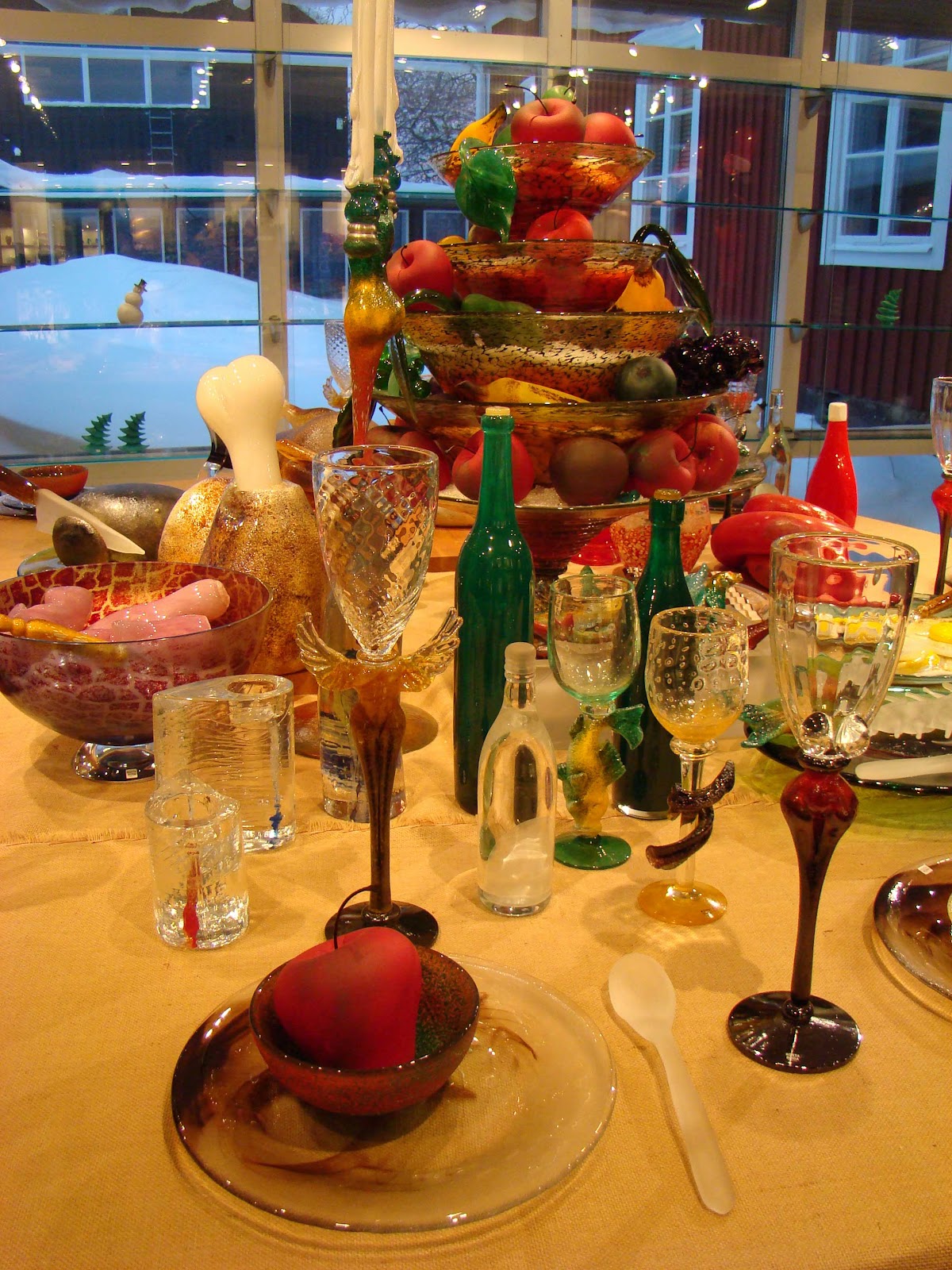
The most impressive however was the Christmas Table dinner room.  Since we had just seen Christmas Tables in Copenhagen, I was surprised to come across something similar, but detailed and special in a different way.  The large table was brimming with food, all carefully hand crafted with glass.  From the fried eggs and plump sausages to the ornate wine glasses and the perfect grapes, the dinner table looked fit for a King!  While you could buy pieces from the table, I couldn't fathom up a reason that I might need a glass fish (it even had glitter so it looked like it had scales) or a Christmas ham (glass knife included) for my home.  Where we did find some good use for our money was in the shops that they have on site.  Browsing through endless aisles of glass, it was tempting not to buy the whole store.  We managed a short break in between shopping for a snack - we ordered pancakes with jam and whip cream along with a Nygårda - a special cola that is only made for the Christmas season.  Insanely sweet, I was happy to later wash it down with a coffee when we finished shopping and headed to the recently opened Glass Hotel.  With everything possible made out of glass, the whole hotel is up for sale.  Like that vase?  How about that plate?  It's all yours for a price.  Not just a lodging facility, this high-classy (and high-glassy) hotel offers rooms designed by Kosta Boda's most prized glass artists and instead of just being a hotel its also a showroom. 

At one end of the hotel there was also a hotel bar - again, with as much glass as possible.  From our bar stools to the floor to the table centerpieces and art decorating the walls, it just felt icy being insde.  While I was thouroughly impressed with the ice bar, I can surely say I think atleast one person was more mesmerized by Kosta Boda - Hillary Clinton.  Turns out, as one of her Secretary of State duties, she elected Kosta Boda crystal be placed in all American embassies around the world! 

After our crystal heaven visit we heading BACK to Växjö to pick up our backs and since we were in town for the second time, her sister to join us for dinner.  Back at the house, Erika's parents served us up a dinner for the history books.  Starting with a plate of fresh salmon, baby shrimps, bread and a tasty sauce, we checked 'fresh seafood' off the must-try in Sweden checklist.  This yummy cool starter was served with a soft white wine from France.  Next round of food was amazing - moose meat (that Erika's dad shot himself), potatoes (boiled just like Grammy and Mom make them), cooked carrots and...drumroll please...gravy!  It may seem crazy to you, but in Basque Country gravy is unknown territory, so to smother my potatoes with a rich gravy was honestly an amazing Christmas present for me.  While the gravy impressed Joseba, he was more in love with the moose.  So in love he was, that he ate about 5 helpings about it.  I imagine any boy who takes 5 helpings of food is any mother's dream, so it was no surprise Erika's mother was beaming.  Accompanying the meat were two Italian reds - one from the north of Italy and one from the middle.  Seeing that Erika's parents like dabbling in wine, we were happy we had brought them a bottle from La Rioja (the wine region in Spain).  After stuffing ourlselves to the brim, Erika's family decided it was time to do some Swedish roots investigating and suggested I call Grammy to learn more about her Swedish past.

Happy to call her, we rang her up, and I am sure she was quite surprised to see a Swedish phone number pop up on her caller ID.  She answered and was thrilled to hear we were calling from Sweden!  I explained to her that Erika's family was very interested in her family past and that possibly her family might have even been from the area I was in at that moment!  Grammy got out her papers and told Erika the names of the family members she had written down.  Turns out her grandmother came from Sweden and left from Gothenburg (a town only about two hours from where I was!).  With the full names, Erika said that since Joseba and I couldn't stay an extra day, she would investigate Grammy's family at the Emigrant House we passed earlier.  After family discussion, Grammy then told Erika some Swedish foods that I should try but sadly during our whole trip, we didn't see any of them!  Erika told me that they were homemade foods and that finding them in cafés and shops would be difficult.  In the end, we had to hang up because God only knows how much a Sweden-USA phone call costs, but Erika told me that Grammy told her she was very happy I was able to spend some time in Sweden and with Erika's caring family.  Later Erika told me she got a bit teary-eyed talking to Grammy, which I must say I did too.  Talking to your Grammy across the Atlantic while she is in your hometown and while you are in her home country is kind of a moving moment!

After so much geneology work, we all sat in the living room and I showed the family where exactly I was from.  Can you believe that Kelso, WA was in the atlas they had?!  Impressive!  Then, Joseba showed them where exactly was Orio - although it wasn't in the atlas - on one of the many maps of Basque Country they had.  Erika's parents made a good effort to visit her atleast once a year, and in doing so have come to know the Basque Country like the back on thier hands!

Before pie, we went on a brisk walk in the cold night, where only the candelabras and advent stars shone from the windows and the streets were covered with packed snow.  Pretending we worked off some of the calories of our delicious dinner, we decided we had earned ourselves some dessert!  A homemade bluberry pie, with hand-picked berries from the forest behind the house, we could only manage small pieces topped with cream because we were so full.

We marched upstairs to tuck ourselves into bed, and Erika's mom showed us up to the room.  Erika's old bedroom to be exact.  Of course the window donned a candelabra and under it, two little wooden figures - which Erika's mom told us were Joseba and I and were for us to take home to always remember Hovmantorp.  With visions of moose dancing in our heads we slept soundly til morning when we were again filled with even more food.  No Wheaties boxes were to be seen, but it was a real breakfast of champions - with white bread, Swedish bread (which is somewhat hard and brown and grainy), cheeses, meat slices, berry yogurt (from a milk carton shaped container), granola (which seems to be called museli on this entire continent, even here in Spain), and leftover Christmas ham served with a spicy mustard.  If I hadn't still been so full from the dinner the night before, I would have eaten more!

After such a short stay in town, we were sad to have to leave the warm and cozy home but alas boarded the train to Stockholm to begin the second leg of our Swedish adventure, but incredibly happy we could see the small town life and how ´real Swedish people´ live.

Puss!
Amanda

Saturday, January 8, 2011

Walking in a Winter Wonderland (part 1)

After an amazing Christmas with Joseba and his family, we headed towards Scandinavia to spend the last few days of 2010 and start 2011 off with a bit of snow and cold temperatures.  After stuffing ourselves with croquettes, shrimp, steaks, desserts (I even made NY Cheesecake) on the 24th and then again on Christmas Day, we took the 26th to relax a bit and then on the 27th we flew north. 

We had known it was going to be cold, with temperatures around -8ºc (which is about 16º or 17ºF) being the regular for this time of year.  Our guide book from the library shared the shocking news with us that the average high in January is about 2º (about 36º).  We also knew we were in for some snow from the European weather forecasts.  A few days before we came, Scandinavia was stormed with a cold blast of snow which cancelled many flights (not ours!).  When we got there, a lot of that snow still blanketed the ground - to the point where the coastline of Denmark when we flew in was just a progression of snow-covered land, to ice-frozen shores to the sea filled with chunks of ice.  Even from the plane it looked chilly! 
After deboarding the plane and getting our suitcases (warning if you ever fly into Copenhagen, we waited for our bags for about 40 minutes!) we headed towards the metro.  We lugged our baggage onto the metro car and went one whole stop and then the metro reversed and dropped us off at the airport again, accompanied by a Danish announcment which barely anyone understood.  Luckily, there was a nice Danish woman (blonde of course) on the train who translated for us that it was too snowy for the metro to run and that we needed to switch to the regional train!  I couldn't beleive it!  Such a snowy city, it must have been a LOT of snow to shut down the metro.  Eventually we made it to the hostel, called Sleep in Heaven.  It is the same hostel I stayed in when I went to Copenhagen solo in Spring.  Not only was it cheap, but it made a good impression on me, so Joseba and I decided to save some euros and lodge at a hostel for our Danish stay.  We arrived at the hostel around 4:30pm and the sun had already set, but that didn't discourage us from hitting the street and seeing the town. 
I remember on my last visit being in love with the rows of colored buildings and this trip, the bright white snow brought that out even more.  Even in the dark, the glowing street lights lit up the road and made it possible to distinguish a gorgeous soft peach building from a warm mint green one.  Even better was watching Joseba observe them with new eyes - each building was his new favorite!  The streets, being cleared well by the fancy snowplows, were easily walkable and we spent the first evening wandering the cobblestone streets.  The main artery streets were decked with hanging lights and on Stroget (the world's longest pedestrian shopping street), the lights were jazzed up even more to include red hearts, just like the Danish coat of arms.  With three lions and nine hearts.  Supposedly based on the seal used by King Canute VI in 1194, the hearts of now are said to have been sea leaves but although a 1972 decree specifically states them so, the Danes carry on for thier love of hearts -which not only decorated the Christmasy street but also thier coins!
We started off our week full of eating with a hotdog from a street cart, which seem to be as ubiqutous to the streets as the hearts that run above them.  Here we asked the man how to say thank you  in Danish and were told it was Tak, so from then on we started to show off our extreme Danish speaking abilities and were very politem, saying tak  to everyone!  After strolling the shopping street and getting lost on the side roads, we eventually realized our tiredness and popped into a restaurant named Sultan's Palace for a Turkish style dinner.  Normally Joseba and I speak in English, but seeing as that almost everyone Dane speaks it perfectly, we switched to Spanish while in public places when we didn't want everyone to hear and understand what we were saying.  However, in this little restaurant, we did a little talking in...BASQUE!  Obviously not a lot, but some! 

The next morning we were up bright and early, which is quite necessary when the sun rises at 8am and sets around 3:30pm!  Blessed with good weather, we retraced our steps from the night before to re-experience all the buildings in daylight.  Making sure to walk carefully, we were constantly avoiding parts of the sidewalk, blocked off for threats of falling snow from the roof.  Even scarier than the clumps of possible snow falling were the size of the pointed icicles hanging from the gutters!  Without getting plummeted by snow nor icicles, we safely made it to Cafe Paluda for breakfast.  What looked like a small café / bookstore from the outside turned out to be an old house that had morphed into a massive bookstore with rooms and rooms full of bookshelves and café tables.  We chose the room next to the windows to watch the passing people as we ate our chocolate croissant, cheese and bread with grapes and our two café lattes.  At leaving time, we bundled up again, which felt more like putting on a fat suit!  Each day I wore at minimum, a tank top, a t-shirt, a sweater or long-sleeved shirt over, then a fleece (sometimes two), a scarf, a big jacket, a hat, gloves and tights under my jeans.  Sometimes it was so many clothes that I could barely lift my arms up because I was too much of a stuffed sausage in my coat!  I never complained though - happy to be warm, and sometimes shocked that even with all these layers, I still managed to get cold.

At the time, I was toasty and we headed off to do some more walking. With no museums on our list, our main goal was to stroll around and see as much of the city as possible.  We finally reached the end of Stroget, which empties out into Amagertorv (Amager Plaza) which holds the world famous Georg Jensen shop along with the Royal Copenhagen store in two 17th century houses.  Having heard about a 'Christmas Tables' exhibit in the Royal Copenhagen store, we entered the red-bricked building.  The company, founded in 1775 is most recognized for thier iconic white and blue porcelain that is oh-so-Danish.  Here there were six rooms decorated like dining rooms for the Royal Family.  Each year a different theme is put in place and for 2010 it was Royal Traditions - so tables were set up to feature Royal Stables, Royal Lifeguards, the Royal Porcelain Factory, the Royal Library, the Royal Horticulture Society and the Royal Orchestra.  As elaborately detailed as Macy's Christmas windows, each table setting was precise and magical, each featuring a set of dishes available to buy at the store.  Here are two of my favorite tables (the Library and the Stables).  Although you cannot not the extreme precision, the Library table is decorated with old books as the feet of the table and the napkin holders were crafted from yellowed book pages.  The Stables table was decorated with hay under the table and saddles atop boxes for the seats, along with pinecones to hold the napkins in place.  It was at the store I learned that while this company used to make porcelain dishes, it's Christmas plates became collectors' items when the Queen liked one set so much she bought some for herself.  Since then, the Royal Copenhagen makes a set of Christmas dishes each year.  Georg Jensen, next door, makes collectible silver dessert serving spoons and forks.
Next stop on the self-made walking tour was to the Nyhavn Canal - a canal lined with a rainbow mix of houses from the 17th century and boats to match.  Designed to make it easier for fisherman to get thier catch to the market, the canal now is a hubub of restaurants, bars and a general people meeting place.  The northern side of the canal boasts colorful townhouses designed with bricks and plaster, one even dating to 1661, while the southern side sports more mansion-like estates in duller but still eye-catching shades.  In summer people hang out along the canal, but being 17º there weren't many people out for socializing and we didn't hold out for too long either.  Walking in inches and inches of snow to get the best view of the buildings that just ooze character along the canal, we eventually made our way back to the center where we stopped off for a kebab sandwich - the next meal in what turned out to be a very international eating vacation.  As I had started to notice, no table in Denmark was left untouched by either a flaming candle or a small poinsetta.  Even at this kebab shop, we had a miniature christmas flower to add to our meal. 

With full tummies we wandered back down Stroget for what we called 'fake shopping' - which includes walking into a shop and pretending to shop while we warmed up.  We became professionals at it!  At the end of Stroget, we ran into Tivoli Gardens, the amusement park set up in 1843.  Entering the Park was something I had been dreaming about since we started planning our trip - not for the rides but for the Christmasland the Park turns into in December.  San Sebastian, while beautiful, is defintiley lacking in Christmas spirit, and although over the top, I was elated to be in a Winter Wonderland, even if just for a few hours.  Paths leading from Christmas light decked cabins to ice sculptures dotted with real pine trees covered with snow was the exact dose of Christmas spirit I needed.  With a smile like a 6-year old the entire time, I sang Joseba the carols as we walked around the holiday heaven.  When it was created, the founder convinced the King to give him a 5-year charter by explaining that when people are having fun, they aren't thinking about politics, and so began the Gardens, and it's true - I didn't think a second about politics, just about happy holidays!

While the lights were glowing throughout the park, the air was still chilly and we decided to pop into a café to do some postcard writing and warm up with a warm drink.  Joseba ordered one of the many teas they offered and I opted for a locally bottled juice called Anton's, which in the end I thought tasted like flowers.  The dark-wooded dining room was lit mainly by candles, and I now have fallen so in love with candles in every room that two days after we got home, I went shopping and bought a bunch of them!  They are lit as I write this blog!


When we left the little café, we were shocked at the sounds and sparks of fireworks being lit by the people in the street.  Don't get me wrong, I love fireworks, but I don't like them going off right next to me!  To evade the booms we crossed the street and wandered until we found a vegetarian restaurant for our dinner dining pleasure!  Tired and full we headed back to the hostel quite early, with a busy day planned for the next day, we wanted to make sure to wake up rested. 


While only a day and a half spent so far in Copenhagen, we were enchanted by this beautiful Danish city and although we were leaving for 5 days, we were looking forward to coming back for a few more days before we headed back home.  More to come soon, as we ventured to Sweden next!


Kys,
Amanda

Friday, December 24, 2010

It's time for a blog

After not writing for so many weeks, I felt it appropriate to write a little blog to wish everyone a Merry Christmas.  So far this year has felt like the most Christmasy of my now 3 years of holidays in Europe.  The previous two years the local government didn't put up Christmas decorations or lights due to the recession and this year they decided to break them out and deck the streets.  Now every main street sports lights on the tree-lined streets and a few decorated Christmas trees dot the town's plazas. 

To make it more festive we somehow got blessed with some snow a few weekends back.  Joseba and I went to our favorite mountain where we normally go hiking and played around in the snow for a few hours, like little kids who have never seen snow!  With such a sunny day, the crisp air wasn't too cold, but the wind that whipped around the moutain made for some sharp ice crystals that poked through our jackets and sometimes made walking almost impossible.  On a mission to do our normal hike to the top, we eventually turned back because we came to a corner and it seemed that each time we tried to make it around the bend the snow blasted in our faces.  Although we didn't make it, we were happy with the gorgeous views and photos we got.  It's not often you see the snow and the beach at the same time!  Between snow angels and snowball fights, we considered our playtime as preparation...because on the 27th we are heading to Copenhagen and Stockholm to ring in the New Year, Scandinavian style. 

The past few days have been all hustle and bustle.  Between arts and crafts with the students and watching Christmas movies, I felt quite festive.  Can you believe I was able to download Mickey Mouse's Christmas Carol, Frosty the Snowman and Ruldolph the Red-Nosed Reindeer!  I was estatic!  The kids loved them as well, but I am sure I was the happiest in the room :)  It feels so much more like Christmas when I watch those movies!  Now with no work, I have been running around, buying some extra sweaters (it's probably going to be around -4º in Denmark and Sweden!) and last night made a cheesecake while rocking out to Christmas music.  I will bring the cheesecake to the Christmas Eve dinner I have tonight with Joseba and his family and then tomorrow we will celebrate Christmas Day again with his family and more extended family too.  Although it's not my USA family, it will be nice to be with family on Christmas. 

Today, I stepped outside while taking a break from decorating the cake and wrapping presents to go buy a tasty breakfast treat and while outside saw the Olentzero parade.  Instead of Santa, as you may remember from a blog two years ago, the Basque's have Olentzero - a miner who comes down from the mountain to leave Christmas presents.  While we send letters to the North Pole, some of my students told me that in the days before Christmas they go to the mountain and leave notes in certain rocks that thier parents tell them Olentzero passes on the way down to the villages.  I guess whether it's Santa or not, kids love to write the letters!  Another funny difference is that I found that while we leave milk and cookies for Santa, the kids here leave Santa/Olentzero cookies and WINE!  I'm sure the parents suggest that idea haha.

Off to finish preparing, but I wish you a very Merry Christmas.  Yet another holiday spent across the pond, but no less Christmas cheer.  I wish only the same for you all!

Merry Christmas!  Eguberri On!  Feliz Navidad!

Thursday, November 11, 2010

Life without wine...is it possible?

Living here, I have become quite accostumed to good wine.  Just a stone's throw away sits the famous Spanish wine region - La Rioja, so a good bottle of wine doesn't really cost more than 3€ or 4€ ($5 or $6).  When we go out for pintxos or take strolls around town and stop in at a bar to warm up, we normally order a wine.  Funny thing is that it costs MORE for a bottle of water here than a glass of wine.  It's like they WANT you to drink the wine, which I buy into easily.  In my apartment, we normally share bottles of wine during the week and usually have a glass each during dinner.  It's a part of life here and has become a part of my life too, but unfortunatley this week...its not!

This week I have a doctor's prescription which highly advises that I don't drink alcohol - or else I might end up puking everywhere.  So, for 10 days, I am not allowed a single drop of wine!  Unbelievable.  It's not really THAT bad, but I guess it makes me take a step back and appreciate the delicious wine I am so accustomed to.  Recognized as the Premier Wine Region in Spain, the Rioja region has been home to vineyeards since the 11th century BC when the Phoenicians settled in the area after traveling up the Ebro River.  Centuries later, the Romans conquered the area and started setting up bodegas all around to supply and sustain the troops.  I read that a 75,000 liters (19,813 gallons) container was unearthed in the region...obviously proving the Romans had some pretty thirsty soldiers!

The reputation of Rioja wine grew in the Middle Ages as pilgrims on the Camino de Santiago trekked through the region on thier way to Santiago, Spain.  When in la Rioja, they of course tested various wines.  With its growing popularity, the wine-makers started to look for ways to spread thier product around and begin shipping bottles to the Basque Country.  Being a very important port area, Rioja wines were able to reach Dutch and English wine merchants, and so the popularity for Spanish wine began to grow.

Once wine-makers learned of oak aging barrels, the shelf-life of the wine was stretched.  This made it possible for the grape juice to find its way all the way to Cuba and Central America.  When epidemics hit Galician and Bordeaux bodegas, the Rioja region capitalized on the situation and supplied the high wine demand with thier wines.

After such a great period of success the Rioja was depleted of any vines after WWII when the country was famished and the government ordered the grapes to be replaced with wheat to feed the Spainairds.  Finally, in the 1960s, the vines were replanted and the wine-makers began to experiment with aging, grapes, etc and made a new and improved Rioja wine, that I happen to appreciate every time I take a sip.

Knowing all this, it really makes you want to have a nice glass of wine no?  Well, you guys go ahead...and I will too, in 10 days! 

Tuesday, November 9, 2010

Bits of Basque

As you know, I signed up this year to learn Basque - one of the so-called most difficult languages in the world to learn.  It's coming along and I feel I am picking it up quite well.  I can feasibly read some things and recognize vocabulary all over town, but am still of course embarassed to speak! 

I go to class with my roommate and we study together from time to time, but I have also bought an extra book of activities that I do on my own and when I see Joseba he corrects them and we go over them together.  Two weeks ago, when I was learning how to say things like 'This is a pencil.  That's a door.  That's not a window, that's a table.' we did some oral practicie - him asking me about things and me having to answer.  The best was when he asked me 'Is this a language school?' and my answer should have been 'No, this isn't a language school, its a house' but in the end, it was both haha!  It makes me laugh, because they are such elemental things, yet I get so excited when I learn a new vocabulary word or can say a more complicated phrase.  I guess that makes me a geek huh?

I am so into it that I have even made myself some flashcards for the vocabulary words.  Seeing as I have a 45-minute bus ride both to and from work, I try to use the time wisely and quiz myself on the bus.  It makes the journey go a bit quicker!

I was passing over my notes today on the bus and realized that for only a month and a few days, I have learned quite a lot.  Not only vocab and grammar, but also some things of the language that I found interesting that I thought you guys might like to learn about.  So here goes...

Days of the Week (aste):
M - Astelehena (translation = first of the week)
T - Asteartea (translation = middle of the week)
W - Asteazkena (translation = last of the week)
Th - Osteguna  F - Ostirala  S - Larunbata  Su - Igandea
So, as you see the first three days of the Basque week follow a pattern.  We learned that this is because before Romans tooks over the area, Basques believed in a 3-day week.  The 4 other days were merely added to keep up with the Joneses. 

Counting:
Basque numbers go in quite different way than our numbers.  Until 29, the numbers go regularly.  However when you get to 30, instead of having a specific number for 30, you say 20 and 10.  For 31 it would be 20 with 11.  Making sense?  I think its quite difficult.  Here, I'll attempt to show you a little of what I mean.
1 - bat, 2 - bi, 3- hiru, 4 - lau..............10 - hamar
11 - hamaika, 12 - hamabi, 13 - hamahiru, 14 - hamalau
20 - hogei, 21 - hogeitabat, 22 - hogeitabi, 23 - hogeitahiru
30 - hogeita hamar,  31 - hogeita hamaika, 32 - hogeita hamabi
40 - here it changes for the next 20 numbers - berrogei, 41 - berrogeita bat, 42 - berrogeita bi

Kind of see a pattern?  I totally underSTAND it but let me tell you, I find it quite hard and always do a little stuttering when someone asks me to say 76 or 92 or some big number! 

Word Formation:
aberatsa = rich -- loosely translated to mean the one who has the animal.  Because this is quite an old language, the people who used to have the animals were the wealthy ones.  Now spoken in the 21st century, some words still show how old language really is.

idaz = word -- from this we get two jobs.  The first is idazlea which translates to mean a fan of words (like being a fan of baseball...but instead, words).  If you're a big fan of words, that makes you a writer!  The other job with this word is idazkaria which means someone who works with words - which becomes a secretary!  As you can see, the suffix changes the word - which is something I am slowly learning to accept.

Basque is just like English
One of the very few things that I can relate from English to Basque is the possessive.  In Spanish, they don't have this 's function like we do.  Steve's book, Laura's car, etc.  Instead, in Spanish you must say the book of Steve or the car of Laura, which gets lengthy.  To my surprise, Basque works like English in this sense.  At the end of someone's name, you put the suffix -ren and it means the same as 's.  For example:
Liburua Steveren da.   or    Kotxe Lauraren da.  or   Hazel Amandaren amona da. 
Granted, the word order is much different, but hooooray something that me, the one English speaker in class can relate to! 

Well, after my flashcards on the bus, my homework when I got back and now this blog, I am Basque-ed out.  In 8 1/2 hours I have class, so I think I will close out this blog and rest up for more Euskera!  But, before I go, I will leave you with a little saying we learned in class:  'Eroriz ikasten da oinez' which means 'you can only learn to walk by falling down'.  One month in, I am still falling down of course - more like tripping all over the place - but am happily in the process of learning this language!

Muxu bat! (A kiss)
Amanda

Sunday, October 24, 2010

Exte berria (The New House)

Although I have lived in my new apartment for over a month, I am just now getting around to posting the photos for you guys to see, and putting up my new address.  The apartment is great!  I started looking with a friend, after sort of realizing that the past two years I have lived here, I never have lived with a friend.  I was always so happy in Arizona and New York with my roommates and liked being at home.  I hadn't had that feeling since I moved to Spain and decided the best remedy was to move in with people I liked and chose to live with.  That said, I now live with my friend Nerea, from a nearby town.  She moved in and we started looking for a nice roommate for the 3rd bedroom.  After ladies who were 40, Americans who couldn't speak a lick of Spanish (Nerea speaks no English) and a bunch of boys calling, we finally found a nice 26-year old ballet teacher from Barcelona. 
We all get along great and most evenings drink wine and watch TV or do our homework together.  Monste (the Barcelona roommate) and I go to Basque classes together, so we study together a lot!  The house feels like a regular apartment to me now - and finally I feel comfortable being at home, such a relief.

Of the 3 bedrooms, I have the exterior one, with a window that lets in a lot of light.  For the occasion of having a flat with people I like, I went all out and finally  bought new sheets, instead of the hand-me-downs I have been using for two years.  My theory the past two years is that I shouldn't spend money on sheets if I am only going to stay a short time.  But now, I admit it to myself, I plan on being here a long time, so I went ahead and bought some sheets.  It makes it feel much more like it is 'my' room.

The best part of the entire apartment is the living area.  Called an 'American Kitchen' in Spanish, the kitchen, dining room and living room are all one room.  Typical for us to see, this set-up is quite unheard of in Spain, so I am happy we found one. 

Back again in Gros, my neighborhood from before, I feel right back at home - with my favorite grocery store, bakery, paper shop, corner store, bars, etc.  The funniest is that I used to live on San Francisco street and now I do again, just a few blocks up the street from my old apartment.  Here is my new address:

c/ San Francisco 42, 2º-2
20002 Donostia - San Sebastian
Guipuzcoa, España - Spain

Sorry for the long delay, but glad I could finally write a blog about my happy home life!

Muxu!


Amanda